BE IN CONTROL OF YOUR TRANSFORMATION
Decision Intelligence
Create your own architecture artefact using Dragon1 Software. Powered with AI.
Browse Library
Select Template
Create Blueprint
Interactive Architecture Dashboard Preview
Executives today face high-stakes decisions with incomplete visibility across their enterprise. Organizations with annual transformation budgets exceeding €500M frequently encounter hidden dependencies, cost overruns, and delayed ROI. Traditional dashboards report outcomes but rarely explain causality, leaving executives reacting to surprises instead of steering proactively.
Dragon1 demonstrates how integrating Enterprise Architecture (EA) with Decision Intelligence delivers predictable financial outcomes, reduces structural risk, and enables strategic agility. Dragon1 provides a unified enterprise architecture intelligence platform to turn architecture and data into actionable capital governance.
With Dragon1, executives can confidently steer strategy execution, ensuring capital is allocated efficiently, risks are quantified, and transformations deliver measurable ROI.
Executive Decisions Reality: Complexity is Outpacing Control
Global enterprises operate in an increasingly complex environment. Strategic initiatives, digital transformations, and capital investments move faster than organizations can fully understand the interdependencies between projects, departments, and systems. While KPI dashboards and BI tools report progress, they rarely indicate root causes, and portfolio decisions are often made in silos.
Executives face systemic blind spots that can lead to costly surprises: unexpected project delays, budget overruns, and opportunity costs. These are not anomalies; they are predictable outcomes of a lack of structural insight. The problem is not ambition—it is a lack of predictive visibility across the enterprise.
Organizations need a framework that connects operational performance, strategic goals, and financial accountability. Without this, initiatives often compete for resources without clarity, creating inefficiencies that ripple through the entire enterprise.
Why Traditional Enterprise Architecture No Longer Suffices
Traditional EA tools offer process maps, system diagrams, and capability inventories. They document the enterprise, but static documentation cannot:
- Simulate financial impact across multiple initiatives
- Predict interdependencies and resource bottlenecks
- Quantify systemic risk at portfolio level
While EA provides necessary structure, it does not allow executives to govern capital or make predictive decisions proactively. To transform strategy into successful execution, a dynamic, predictive capability is required—one that connects architecture, data, and finance.
Static EA may describe what exists, but it cannot forecast what will happen. The inability to model “what-if” scenarios leaves executives exposed to unforeseen costs and missed opportunities, reducing the effectiveness of even the most sophisticated planning processes.
The Analytics Illusion
Business Intelligence dashboards provide revenue trends, cost reports, and KPIs. Yet metrics alone cannot answer critical questions:
- Why is this initiative over budget?
- What dependencies will cause delays next quarter?
- How do changes in one domain ripple across the enterprise?
Data without context gives the illusion of control. Decision-makers see numbers, but they cannot foresee consequences. For executives, this creates a false sense of confidence and exposes the organization to hidden financial risk.
Organizations often invest in BI without integrating EA, leading to a proliferation of dashboards that look informative but fail to connect with enterprise-wide realities. Dragon1 solves this by embedding performance analytics within the enterprise's structural context, transforming insights into actionable decision intelligence.
The Blind Spot in Executive Decision-Making
Executives often allocate capital across portfolios, IT programs, and reorganizations without understanding the enterprise-wide impact. Snapshots from partial tools fail to reveal systemic risk.
Consequences include:
- Hidden dependencies causing delays
- Overruns on budgets and resources
- Misaligned KPIs and missed strategic goals
Dragon1 fills this blind spot by enabling predictive structural visibility, turning reactive correction into proactive governance. Executives can model scenarios, quantify risk, and foresee the financial impact of decisions before execution.
The ability to predict outcomes enables leadership to focus on high-value initiatives, reducing wasted effort and ensuring that every strategic move contributes to measurable business objectives.
“The future belongs to organizations that turn
architecture and data
into
decision intelligence.”
Financial Scenario – Core Case
Context
A global enterprise spends €500M annually on strategic initiatives, including digital transformations, IT modernization, and organizational change programs. Historically, 30–40% of projects experience cost overruns, delays, and lagging KPIs.
Executives approve initiatives based on high-level business cases. Dashboards show performance, but structural dependencies and risk are invisible. Outcomes include:
- Hidden interdependencies causing €45–60M in unexpected costs per year
- Opportunity cost from delayed initiatives up to €50M
- Decision cycles averaging 12 weeks, slowing capital allocation
Dragon1 Decision Intelligence Solution
By integrating EA with Decision Intelligence, the enterprise can:
- Simulate initiative impact before funding – model cross-domain dependencies, resource constraints, and potential delays.
- Link KPIs to architecture – forecast financial outcomes and strategic alignment before execution.
- Quantify structural risk – identify high-risk initiatives proactively to prevent overruns.
Executives can now predict the ripple effect of decisions, align initiatives with strategic goals, and avoid hidden costs. Decision-making becomes evidence-driven, enabling both speed and accuracy in capital allocation.
Outcome – Core Case
Decisions shift from reactive correction to proactive steering:
- Transformation overruns drop from 30–40% → 5–7%
- Capital leakage reduces from €45–60M → €8–10M
- Decision cycle time shortens from 12 weeks → 9 weeks
- Predictable ROI increases, strategic agility improves
- Executives steer capital, not just monitor it
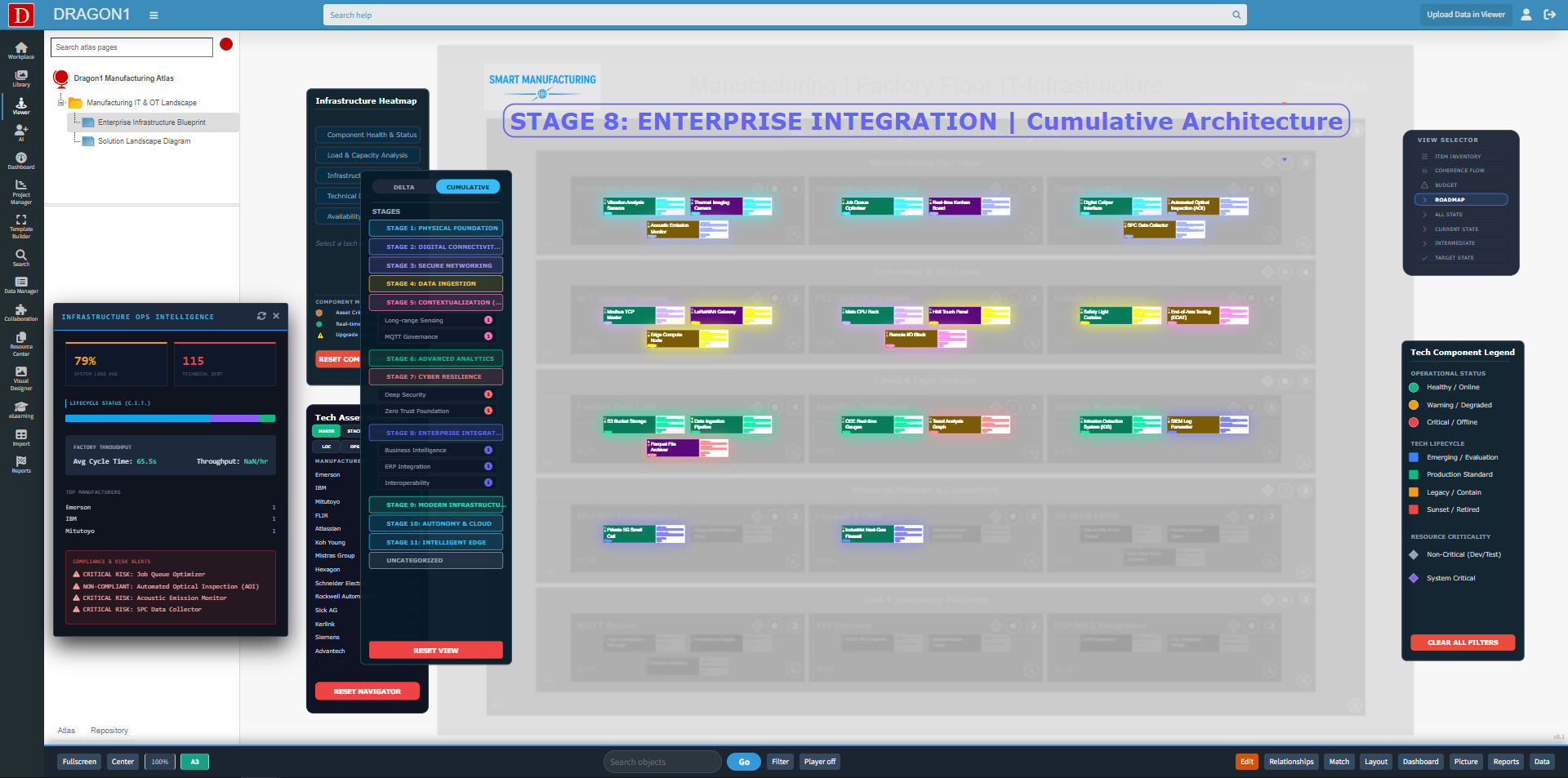
Decision Intelligence, IT Infrastructure Manufacturing Roadmap.
The enterprise now has actionable insight into initiative dependencies, risk exposure, and financial outcomes, allowing leadership to act decisively and ensure measurable success. Strategic initiatives are no longer reactive; they are purposefully designed for maximum impact.
Strategic Shift to Decision Intelligence
The organizations that adopt Dragon1 experience tangible improvements across finance, operations, and strategy. Capital allocation cycles accelerate by approximately 25%, reducing the time executives spend approving initiatives and reallocating resources. Transformation overruns decrease by 30–35%, preventing tens of millions in avoidable costs annually. Predictable ROI becomes the norm rather than the exception, with performance monitored and forecast across the entire portfolio.
Strategic agility improves as executives gain real-time insight into dependencies and resource constraints, allowing for faster adjustments without risking systemic disruption. Opportunity costs shrink because initiatives are prioritized based on projected financial impact rather than assumptions or historical patterns.
Dragon1 enables a structural transformation in governance. Organizations move from static documentation and reporting to dynamic, predictive decision-making. An integrated view of architecture, performance, and financial risk replaces isolated analytics.
Executives now can make capital deployment decisions with precision, balancing risk and opportunity across initiatives. Decisions that previously relied on assumptions or delayed reporting are now based on simulations, forecasts, and structural insight. This shift transforms strategy execution from reactive correction to proactive steering, delivering both financial efficiency and competitive advantage.
Competitive Advantage Intelligent Visualization Layer
Competitors relying on traditional EA tools, BI dashboards, or consultancy frameworks remain blind to the full implications of their strategic decisions. Without integrated structural intelligence, they experience higher risk exposure, slower execution, and unpredictable ROI.
Organizations leveraging Dragon1 gain systemic foresight, deploying capital with greater accuracy, executing initiatives with lower variance, and absorbing complexity faster. This advantage compounds over time: faster strategy cycles lead to faster learning, more informed decisions, and ultimately, superior financial and strategic outcomes.
Proof of Concepts: Enterprise Architecture & Decision Intelligence in Action
📊
Transforming Finance Operations
Finance executives used Dragon1 to connect processes and KPIs, reducing decision cycles by 30% and improving portfolio visibility.
🛡️
Risk Management in IT Projects
IT teams leveraged predictive scenarios to identify risks early, avoiding costly delays and improving on-time project delivery by 40%.
🎯
Optimizing Corporate Strategy
Executives simulated changes across business units using KPI dashboards, achieving 25% faster alignment of initiatives with corporate objectives.
📈
Streamlining Project Portfolios
Portfolio managers identified dependencies across programs, optimized resource allocation, and improved overall project delivery by 20%.
AI Decision Intelligence
Artificial Intelligence is rapidly becoming a strategic enterprise capability. Organizations must continuously decide where to invest in AI, which initiatives create business value, which risks are acceptable, and how AI supports long-term business objectives. These decisions cannot be based on technology trends alone. They require visibility into business impact, dependencies, costs, risks, and expected outcomes.
Many organizations struggle to evaluate AI initiatives because information is fragmented across departments, projects, applications, and data platforms. Business cases are often based on assumptions, while the broader impact on capabilities, operations, and enterprise architecture remains unclear. As a result, organizations risk investing in AI solutions that deliver limited value or create unintended consequences.
Dragon1 extends Decision Intelligence by connecting AI initiatives to enterprise architecture, business capabilities, KPIs, and transformation roadmaps. By visualizing relationships among AI systems, business processes, data sources, and strategic objectives, decision-makers gain a holistic understanding of how AI affects the enterprise and where investments generate the greatest value.
Using architecture-driven scenario analysis, organizations can compare alternative AI strategies, evaluate potential outcomes, and understand the consequences of decisions before implementation. This enables executives, architects, and transformation leaders to prioritize initiatives based on measurable business impact rather than assumptions or isolated metrics.
As AI adoption accelerates, organizations need more than dashboards and reports. They need a structured way to assess opportunities, predict outcomes, and align AI investments with enterprise goals. Dragon1 combines Enterprise Architecture and Decision Intelligence to help organizations make informed, transparent, and value-driven decisions about AI transformation.