Create User Defined Attributes
Note: the video is without sound or narration.
Dragon1 supports creating user-defined attributes or properties to any entityclass.
You can extend, for example, a Process or Application with special costs or management attributes.
Also, you can create a default list of attributes in your account for a specific entityclass.
How to Add User-Defined Attributes (Architecture Repository)
To add user-defined attributes:
- Go to the Architecture Repository
- Open a cabinet and select a folder
- Select / Click on a data object in the folder
- Now you see a form with the data attributes of that data object
- Click on Edit Form
- Now enter the name of an attribute
- Click on Add Attribute to create a new attribute
- Click on Update Attributes to store your changes
- Click on Edit Form to go back to the data form
- Now you see you can enter values for your attributes in this form (scroll down to see them)
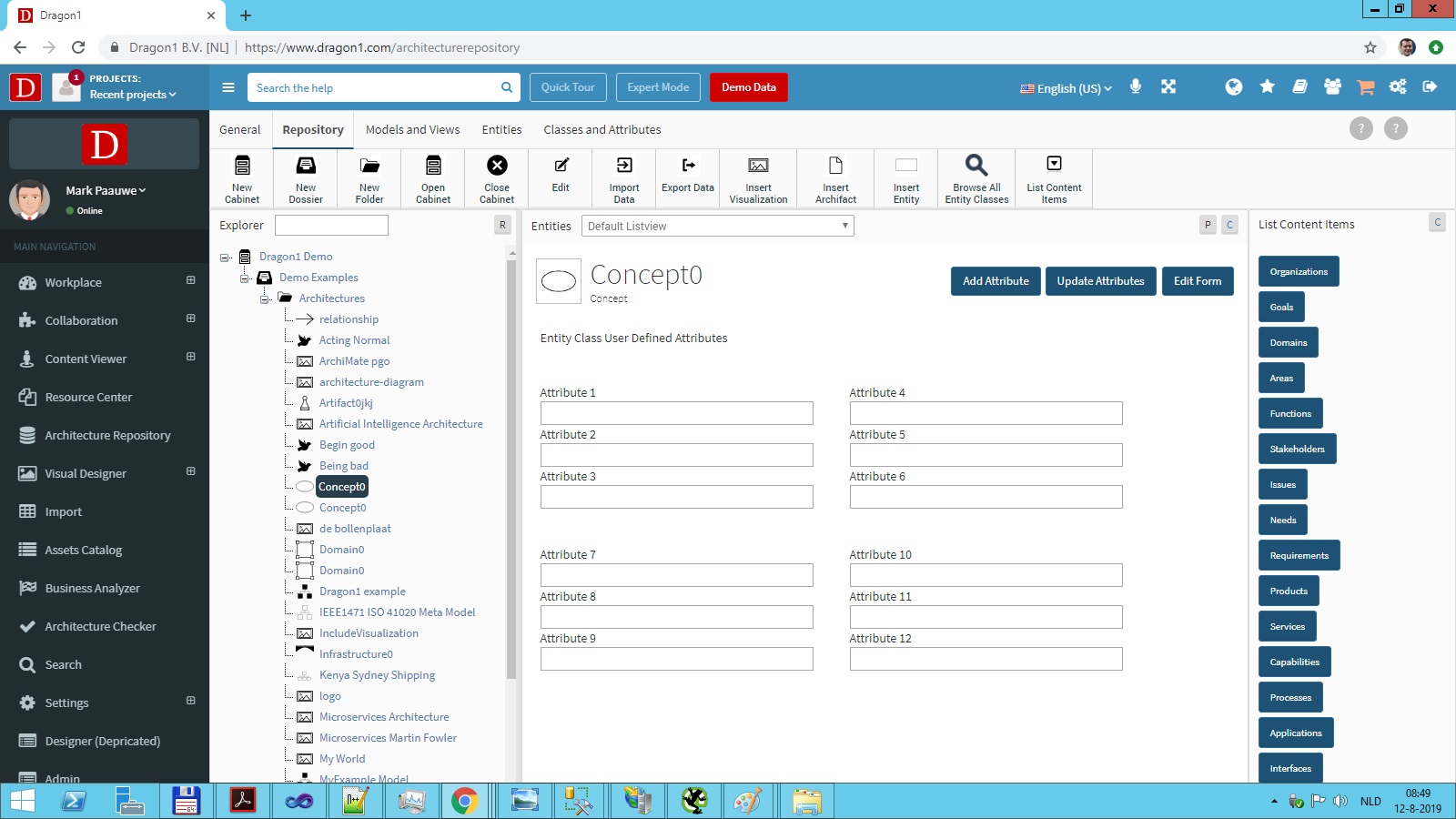
Add User-Defined Attributes in the Architecture Repository.
How to Add User-Defined Attributes (Visual Designer)
To add user-defined attributes:
- Go to the Visual Designer
- Open a cabinet and select a folder
- Select / Click on a data object in the folder
- At the top right-hand side, you see the generic attributes of the data object.
- Here, you can add, update, and delete user-defined attributes.
- If a list of default attributes is configured in your account, you will also see these attributes here.
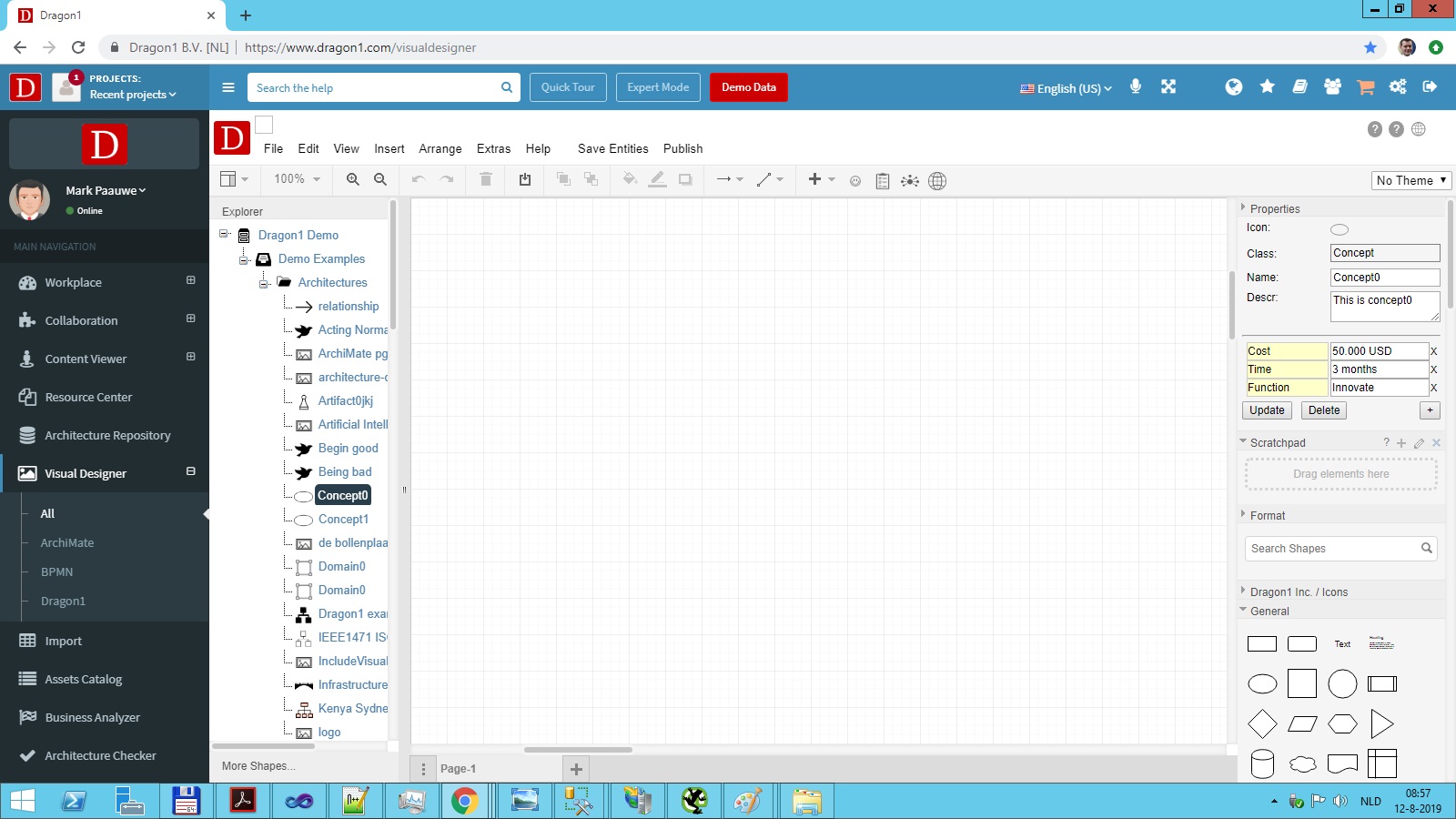
Add User-Defined Attributes in the Visual Designer.
Attributes vs Variables
While attribute and variable are often used interchangeably in data analysis and programming, they are not strictly the same thing. They represent different perspectives on data.
Attribute (Characteristic): An attribute is a specific quality, trait, or property of an object (e.g., eye color, gender, model name). It often describes what the entity is, sometimes in non-numerical, categorical terms.
Variable (Measurement): A variable is an operationalized representation of an attribute, taking on different values across a dataset (e.g., age in years, temperature in Celsius). Variables are often used for calculations and statistical analysis.